

The most expensive holiday displays this year use fewer lights than they did five years ago.
That’s not a typo. The biggest shift in Christmas lighting isn’t about adding more. It’s about placing less, more deliberately, and letting technology handle the rest. Properties chasing maximum bulb count are starting to look dated next to displays built on restraint and architectural focus.
Here’s what this article covers:
- Why permanent lighting systems are the biggest trend of 2026
- Warm white dominance and what’s driving it
- Minimalist elegance and the shift to architectural focus
- Smart lighting and RGBWW color technology
- The vintage bulb resurgence
- Color palettes trending this season
- Sustainability and energy efficiency
- Which trends are worth following and which aren’t
We’ve been installing holiday lighting across Florida for over 33 years, and our commercial and residential teams see these shifts play out in real projects before they hit design blogs. Here’s what’s actually landing with clients this season.
Permanent Lighting Systems Are the Biggest Trend of 2026
If there’s one change reshaping the entire industry, this is it.
Why Permanent Systems Went Mainstream
Permanent Christmas lights were a niche product five years ago. In 2026, they’re the fastest-growing service in the category. Homeowners and commercial property managers are tired of the annual install-and-remove cycle, and the technology has finally matured enough to justify the investment.
These are discreet, architecturally mounted LED channels that sit tucked into rooflines and soffits. Off, they’re nearly invisible. On, they produce everything from full holiday displays to everyday accent lighting.
The Cost Math That’s Driving Adoption
This is where the conversation usually turns. Permanent lighting jobs average $3,000 to $8,000 depending on property size and complexity. Annual professional installation runs $1,500 to $3,500 for most properties.
| Approach | Upfront | Annual Cost | 10-Year Total |
|---|---|---|---|
| Seasonal installation | $0 | $1,500 to $3,500 | $15,000 to $35,000 |
| Permanent system | $3,000 to $8,000 | Minimal (energy only) | $3,000 to $8,000 |
Most properties break even in years two to four. After that, it’s pure savings. Our guide on permanent Christmas lights cost walks through the full breakdown.
Beyond Christmas: The Real Selling Point
One installation handles the entire year: orange for Halloween, red white and blue for the Fourth, school colors on game days, soft warm white as everyday accent lighting the rest of the time.
Is a permanent Christmas lights worth it investment? For properties that decorate every year, the answer has shifted decisively toward yes. We cover the full range on our permanent lighting page.
Warm White Dominance Across Luxury Installs
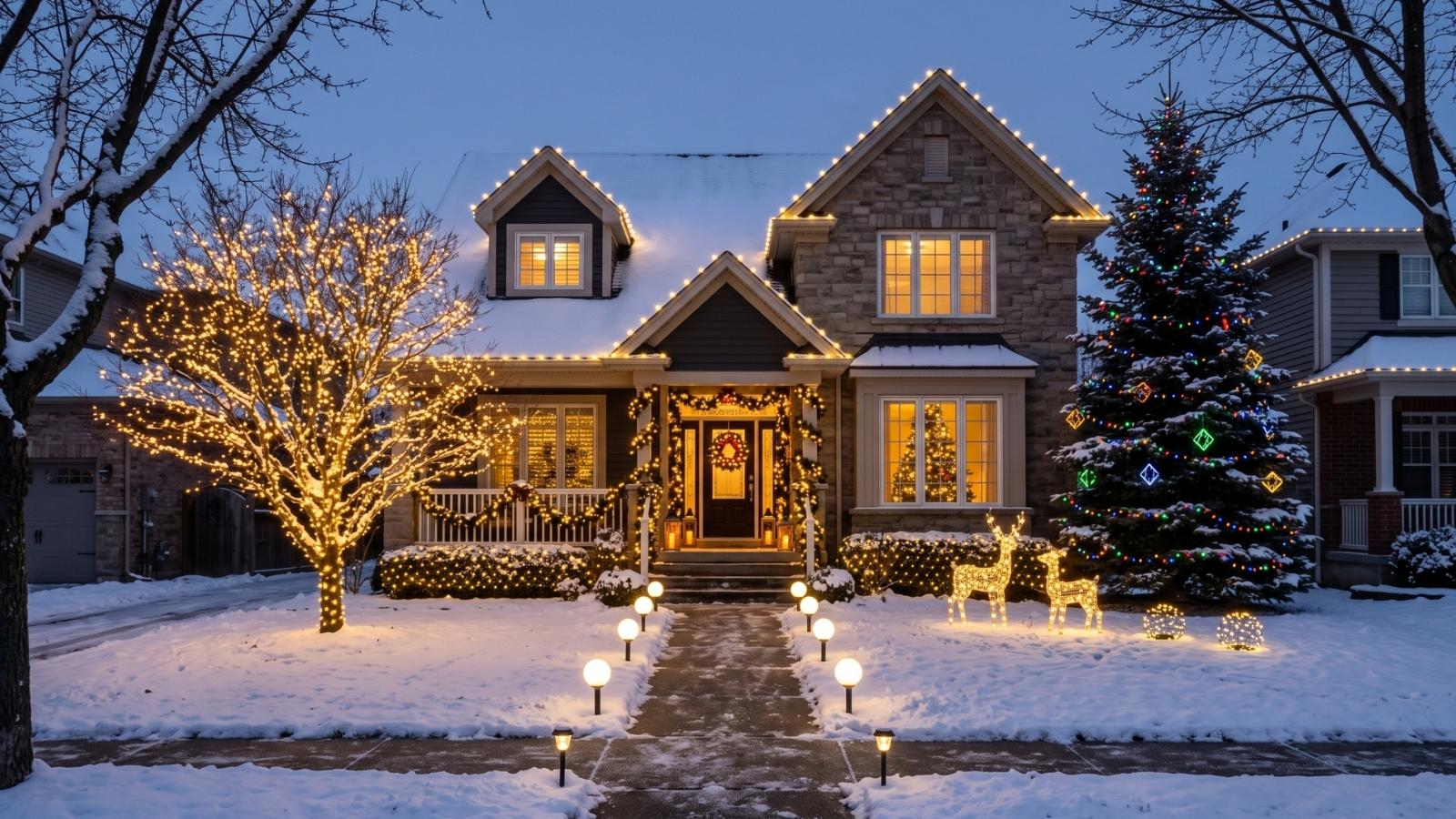
If you look at one data point this year, make it this one.
The Number That Says Everything
Over 70% of luxury installs in 2026 used warm white lighting. Not multicolor. Not cool white. Warm white.
That’s a dramatic consolidation from even three years ago, when color palettes were far more fragmented across high-end properties.
Why Warm White Won
Several forces converged here:
- It photographs beautifully. In an era where every display ends up on a camera, warm white renders cleanly without the color casting that multicolor produces.
- It reads as elegant, not novelty. Warm white complements architecture rather than competing with it.
- It works with existing landscape lighting. No jarring temperature mismatch between holiday and permanent fixtures.
- It ages well. Warm white displays don’t look dated the way trend-driven color schemes do.
Where Multicolor Still Belongs
Warm white dominance doesn’t mean color is dead. Multicolor still thrives in family-focused residential displays, community parks, and retail environments where playfulness is the brand. The shift is specifically in upscale residential and commercial properties, where a clean and polished guest experience is the priority.
Minimalist Elegance and the Architectural Focus Shift
This trend explains the fewer-lights paradox from the top of the article.
Fewer Lights, Better Placement
Decorators in 2026 are focusing on architectural details rather than blanket coverage. Instead of outlining every surface, designers highlight specific features: a dramatic entryway, a roof pitch, a column line, a single sculptural palm.
The result is cleaner, more intentional, and considerably more expensive per foot.
The Pricing Reality
Minimalist installations command 30 to 50% higher pricing per linear foot than traditional full-coverage displays. That surprises people until they understand why: minimalist work requires more design time, more precise placement, and higher-quality product since every bulb is visible and scrutinized.
You’re not paying for fewer lights. You’re paying for the judgment behind where they go.
What Minimalist Actually Looks Like
- Clean lines along a single roofline rather than every edge
- Strategic uplighting on architectural features instead of wrapping everything
- Select tree wraps on two or three specimen trees, not the entire landscape
- Deliberate negative space that lets lit elements read clearly
Layered Ambience Over Brightness
A related shift: designs are moving toward ambient settings with deeper layers and texture rather than maximum brightness. Think dimmed warm white washes, subtle uplighting, and depth created through light levels rather than bulb count. It’s the difference between a space that glows and one that’s simply lit.
Smart Lighting and RGBWW Color Technology
Smart integration went from premium upgrade to baseline expectation this year.
What Clients Now Expect as Standard
Smart home integration is no longer a differentiator in 2026. Customers expect app control, scheduling, and scene presets as a core part of any permanent lighting system. Delivering a system without it feels incomplete.
Standard smart features now include:
- Full color and brightness control from a phone
- Scheduled on and off times by season
- Preset scenes for different holidays and events
- Music sync for special occasions and parties
- Zone control to light different areas independently
RGBWW: The Technology Behind It
RGBWW systems (red, green, blue, warm white, plus a second white channel) are what make this versatility possible. A single installation produces true warm white for everyday accent lighting and saturated color for holidays, with no bulb changes required.
This is the technical reason permanent systems finally became practical. Earlier RGB systems could produce color but delivered a poor, bluish white. RGBWW solved that.
The Value Add for Installers and Clients
Smart lighting integration increases project values by $800 to $1,500 on average. For clients, that premium buys genuine year-round utility. For commercial properties, it means one system covers Christmas, brand activations, and everyday architectural lighting.
Projection Mapping for Large Commercial Displays
At the commercial scale, projection mapping continues to gain ground for creating animated holiday displays on building facades. It’s an art-driven approach that turns a static wall into a moving scene, and it’s increasingly common in municipal and retail environments where the display itself is the attraction.
The Vintage Bulb Resurgence
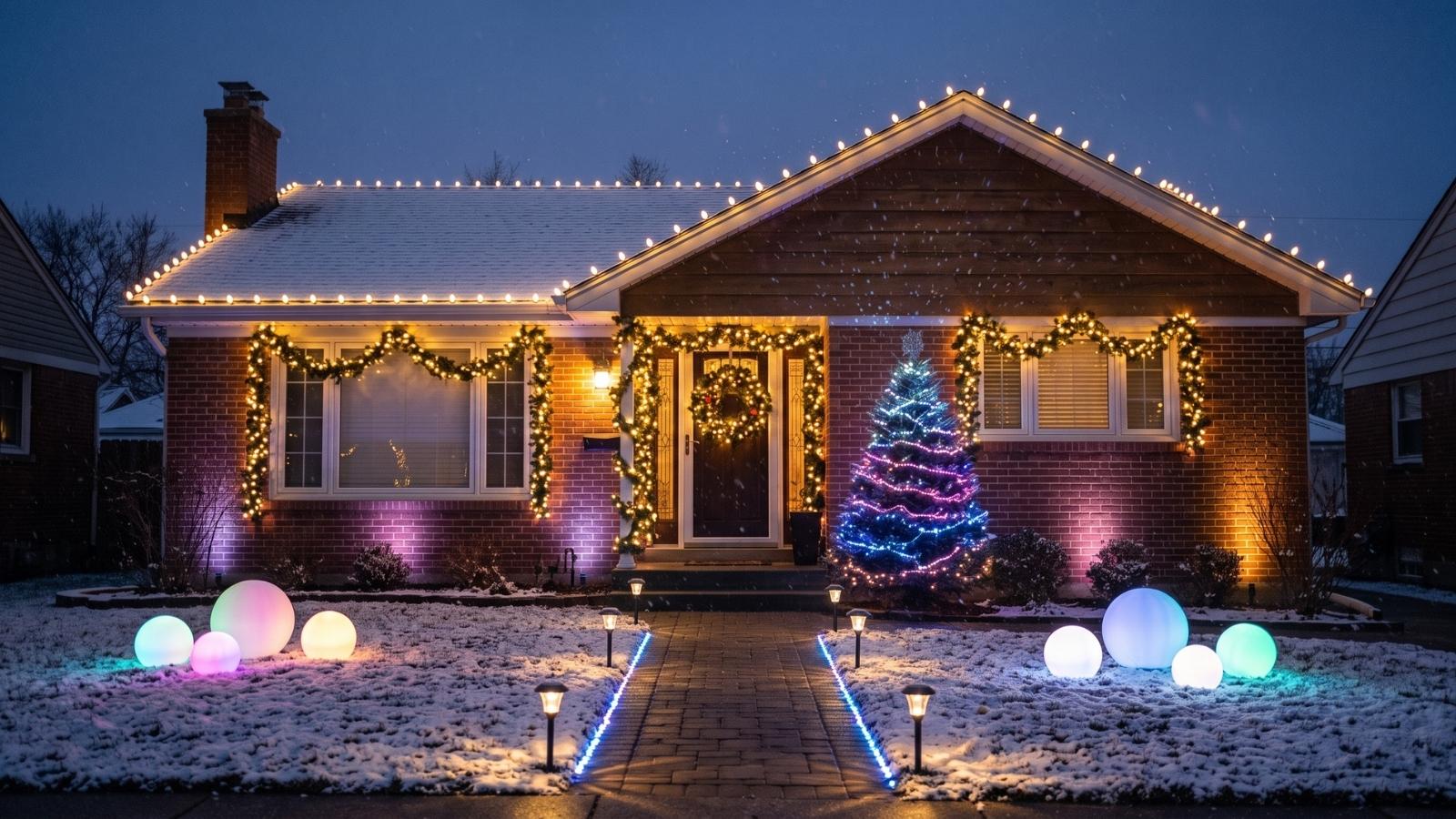
Not every 2026 trend points toward new technology.
C7 and C9 Bulbs Are Back
Vintage-style C7 and C9 bulbs are experiencing a genuine resurgence. Their larger, spaced format delivers the nostalgic look of classic mid-century displays, but modern LED versions produce it with a fraction of the energy draw and none of the heat.
Why the Revival Makes Sense Now
The vintage look pairs naturally with the minimalist trend. Larger bulbs spaced further apart create clean lines with visual weight, which is exactly what architectural-focus designs need. Mini lights still dominate tree wraps and detail work, but C9s are increasingly the choice for rooflines and structural outlines.
Where They Work Best
- Roofline outlines on traditional and colonial architecture
- Commercial storefronts going for a warm, nostalgic brand feel
- Pathway and fence lines where spacing reads well
- Any property where the goal is classic rather than contemporary
Color Palettes Trending This Season
Color isn’t gone. It’s just more disciplined than it used to be.
Traditional Red and Green, Reimagined
Classic red-and-green is returning, but with restraint. Instead of alternating bulbs along every line, designers are using geometric placement: red on one architectural plane, green on another, or color concentrated in a single focal area against a warm white base.
Blue, Silver, and Gold Combinations
Cool-toned palettes remain strong in modern and coastal properties. Blue and silver read as winter without reading as Christmas specifically, which extends the display window. Gold paired with warm white is the most requested upscale combination we see, particularly on Mediterranean and Spanish-style Florida architecture.
Updated Cascading and Icicle Effects
Cascading and icicle lighting effects are back, rebuilt with modern LED technology. The old versions looked cheap and failed constantly. Current commercial-grade versions produce a controlled, even drip effect that works beautifully along eaves and pergolas.
The Overall Direction: Curated, Not Chaotic
Across every palette, the throughline is the same. Festive displays in 2026 are shifting toward curated elegance rather than chaotic patterns. Fewer competing colors, more intentional relationships between them.
Sustainability and Energy Efficiency
Green considerations moved from talking point to purchase driver this year.
Modern Displays Are Dramatically Greener
Christmas lighting in 2026 is significantly more efficient than it was a decade ago. Commercial LED systems last 10 to 15 years while using a fraction of the energy incandescent displays required.
What Efficiency Looks Like in Practice
| Factor | Incandescent | Commercial LED |
|---|---|---|
| Energy use | Baseline | 80 to 90% less |
| Lifespan | 1 to 3 seasons | 10 to 15 years |
| Heat output | High | Minimal |
| Reusability | Poor | Designed for repeated outdoor use |
Reusable Product as a Sustainability Strategy
Commercial-grade LEDs are built for repeated outdoor deployment, which means the same product serves a property for a decade instead of landing in a dumpster every January. Permanent systems take this further by eliminating the install-and-discard cycle entirely.
For commercial properties weighing this, our guide on sustainable, energy-efficient holiday decor covers the full picture.
Which Trends Are Worth Following and Which Aren’t
Not every trend deserves your budget. Here’s our honest read.
Worth the Investment
These deliver genuine value across years, not just one holiday season:
- Permanent lighting systems. The cost math works for any property that decorates annually.
- Warm white as a base palette. It won’t look dated in three years.
- Commercial-grade LED product. The lifespan difference is not marginal.
- Smart control integration. Once you have it, going back feels impossible.
- Architectural focus over full coverage. Better result, often comparable cost.
Approach With Caution
- Heavy projection mapping on residential properties. Impressive at commercial scale, often overkill on a house.
- Extreme minimalism on family-focused homes. If your household wants joy and color, a restrained display can feel cold.
- Chasing novelty color palettes. This year’s trendy combination is next year’s regret.
The Rule That Beats Every Trend
Personal taste and property fit outrank any trend list, including this one. A display that suits your architecture, your brand, and the life happening inside the house will always outperform one that follows a trend it doesn’t match. We tell clients this during every design consultation, and it’s why we don’t hand anyone a template. You can see the range of styles we’ve built in our gallery.
Bring 2026’s Best Trends Home with Trimmers Holiday Decor
The through-line across every 2026 trend is intentionality. Better placement, better technology, better product, and displays designed to last beyond a single season. The properties that stand out this year aren’t the brightest. They’re the most deliberate.
Key takeaways from this guide:
- Permanent lighting systems are the fastest-growing category and break even in 2 to 4 years
- Warm white dominates, appearing in over 70% of luxury installs
- Minimalist, architecture-focused designs command 30 to 50% higher per-foot pricing
- RGBWW and smart control are now baseline expectations, adding $800 to $1,500 in value
- Vintage C7 and C9 bulbs are back, rebuilt with efficient LED technology
- Commercial LED systems last 10 to 15 years with 80 to 90% lower energy use
- Trends are a starting point; property fit and personal taste decide the final design
We design and install displays built around all of this: permanent systems, smart integration, commercial-grade LED product, and architecture-first design. Booking earlier gives you the best install window, and our schedule fills fast. Get a free quote and we’ll build a proposal around your property and your vision.
FAQs
What is the Christmas decor trend for 2026?
Minimalist elegance. Fewer lights placed strategically on architectural features, warm white palettes, and permanent lighting systems that work year-round rather than seasonal installs.
What is the Christmas color of 2026?
Warm white. Over 70% of luxury installations used it this year, often paired with gold accents for upscale properties or restrained red and green for traditional looks.
What are the trendy Christmas design ideas for 2026?
Architectural uplighting, vintage C7 and C9 bulbs, layered ambient lighting, geometric red-and-green placement, updated LED icicle effects, and smart RGBWW systems with app control.
What are the lighting trends for 2026?
Permanent LED systems, smart home integration, warm white dominance, minimalist placement over full coverage, and energy-efficient commercial-grade products lasting 10 to 15 years.


